 Add to Chrome
 Add to Firefox
 Add to Edge
OptiVote: Non-Coherent FSO Over-the-Air Majority Vote for Communication-Efficient Distributed Federated Learning in Space Data Centers
Dec 30, 2025
The rapid deployment of mega-constellations is driving the long-term vision of space data centers (SDCs), where interconnected satellites form in-orbit distributed computing and learning infrastructures. Enabling distributed federated learning in such systems is challenging because iterative training requires frequent aggregation over inter-satellite links that are bandwidth- and energy-constrained, and the link conditions can be highly dynamic. In this work, we exploit over-the-air computation (AirComp) as an in-network aggregation primitive. However, conventional coherent AirComp relies on stringent phase alignment, which is difficult to maintain in space environments due to satellite jitter and Doppler effects. To overcome this limitation, we propose OptiVote, a robust and communication-efficient non-coherent free-space optical (FSO) AirComp framework for federated learning toward Space Data Centers. OptiVote integrates sign stochastic gradient descent (signSGD) with a majority-vote (MV) aggregation principle and pulse-position modulation (PPM), where each satellite conveys local gradient signs by activating orthogonal PPM time slots. The aggregation node performs MV detection via non-coherent energy accumulation, transforming phase-sensitive field superposition into phase-agnostic optical intensity combining, thereby eliminating the need for precise phase synchronization and improving resilience under dynamic impairments. To mitigate aggregation bias induced by heterogeneous FSO channels, we further develop an importance-aware, channel state information (CSI)-free dynamic power control scheme that balances received energies without additional signaling. We provide theoretical analysis by characterizing the aggregate error probability under statistical FSO channels and establishing convergence guarantees for non-convex objectives.

Achieving Equilibrium under Utility Heterogeneity: An Agent-Attention Framework for Multi-Agent Multi-Objective Reinforcement Learning
Nov 12, 2025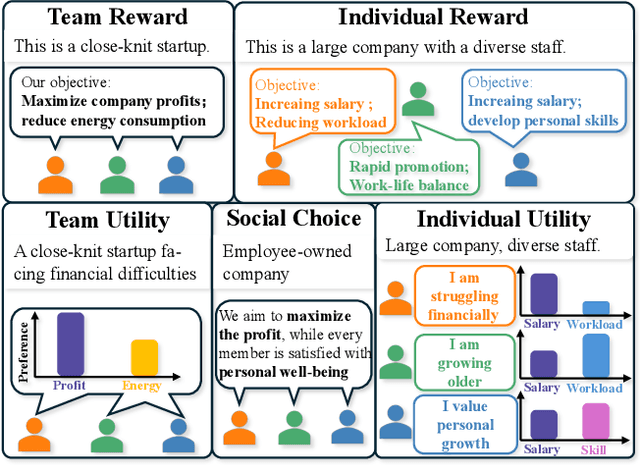
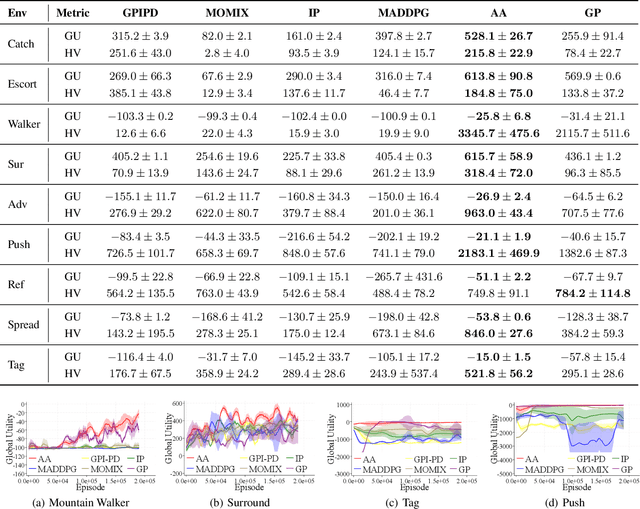
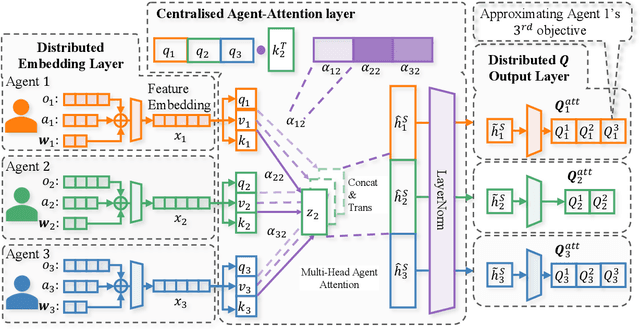
Multi-agent multi-objective systems (MAMOS) have emerged as powerful frameworks for modelling complex decision-making problems across various real-world domains, such as robotic exploration, autonomous traffic management, and sensor network optimisation. MAMOS offers enhanced scalability and robustness through decentralised control and more accurately reflects inherent trade-offs between conflicting objectives. In MAMOS, each agent uses utility functions that map return vectors to scalar values. Existing MAMOS optimisation methods face challenges in handling heterogeneous objective and utility function settings, where training non-stationarity is intensified due to private utility functions and the associated policies. In this paper, we first theoretically prove that direct access to, or structured modeling of, global utility functions is necessary for the Bayesian Nash Equilibrium under decentralised execution constraints. To access the global utility functions while preserving the decentralised execution, we propose an Agent-Attention Multi-Agent Multi-Objective Reinforcement Learning (AA-MAMORL) framework. Our approach implicitly learns a joint belief over other agents' utility functions and their associated policies during centralised training, effectively mapping global states and utilities to each agent's policy. In execution, each agent independently selects actions based on local observations and its private utility function to approximate a BNE, without relying on inter-agent communication. We conduct comprehensive experiments in both a custom-designed MAMO Particle environment and the standard MOMALand benchmark. The results demonstrate that access to global preferences and our proposed AA-MAMORL significantly improve performance and consistently outperform state-of-the-art methods.
Spectral Efficiency-Aware Codebook Design for Task-Oriented Semantic Communications
Aug 06, 2025Digital task-oriented semantic communication (ToSC) aims to transmit only task-relevant information, significantly reducing communication overhead. Existing ToSC methods typically rely on learned codebooks to encode semantic features and map them to constellation symbols. However, these codebooks are often sparsely activated, resulting in low spectral efficiency and underutilization of channel capacity. This highlights a key challenge: how to design a codebook that not only supports task-specific inference but also approaches the theoretical limits of channel capacity. To address this challenge, we construct a spectral efficiency-aware codebook design framework that explicitly incorporates the codebook activation probability into the optimization process. Beyond maximizing task performance, we introduce the Wasserstein (WS) distance as a regularization metric to minimize the gap between the learned activation distribution and the optimal channel input distribution. Furthermore, we reinterpret WS theory from a generative perspective to align with the semantic nature of ToSC. Combining the above two aspects, we propose a WS-based adaptive hybrid distribution scheme, termed WS-DC, which learns compact, task-driven and channel-aware latent representations. Experimental results demonstrate that WS-DC not only outperforms existing approaches in inference accuracy but also significantly improves codebook efficiency, offering a promising direction toward capacity-approaching semantic communication systems.
HiLight: A Hierarchical Reinforcement Learning Framework with Global Adversarial Guidance for Large-Scale Traffic Signal Control
Jun 17, 2025Efficient traffic signal control (TSC) is essential for mitigating urban congestion, yet existing reinforcement learning (RL) methods face challenges in scaling to large networks while maintaining global coordination. Centralized RL suffers from scalability issues, while decentralized approaches often lack unified objectives, resulting in limited network-level efficiency. In this paper, we propose HiLight, a hierarchical reinforcement learning framework with global adversarial guidance for large-scale TSC. HiLight consists of a high-level Meta-Policy, which partitions the traffic network into subregions and generates sub-goals using a Transformer-LSTM architecture, and a low-level Sub-Policy, which controls individual intersections with global awareness. To improve the alignment between global planning and local execution, we introduce an adversarial training mechanism, where the Meta-Policy generates challenging yet informative sub-goals, and the Sub-Policy learns to surpass these targets, leading to more effective coordination. We evaluate HiLight across both synthetic and real-world benchmarks, and additionally construct a large-scale Manhattan network with diverse traffic conditions, including peak transitions, adverse weather, and holiday surges. Experimental results show that HiLight exhibits significant advantages in large-scale scenarios and remains competitive across standard benchmarks of varying sizes.
OmniGenBench: A Modular Platform for Reproducible Genomic Foundation Models Benchmarking
May 20, 2025The code of nature, embedded in DNA and RNA genomes since the origin of life, holds immense potential to impact both humans and ecosystems through genome modeling. Genomic Foundation Models (GFMs) have emerged as a transformative approach to decoding the genome. As GFMs scale up and reshape the landscape of AI-driven genomics, the field faces an urgent need for rigorous and reproducible evaluation. We present OmniGenBench, a modular benchmarking platform designed to unify the data, model, benchmarking, and interpretability layers across GFMs. OmniGenBench enables standardized, one-command evaluation of any GFM across five benchmark suites, with seamless integration of over 31 open-source models. Through automated pipelines and community-extensible features, the platform addresses critical reproducibility challenges, including data transparency, model interoperability, benchmark fragmentation, and black-box interpretability. OmniGenBench aims to serve as foundational infrastructure for reproducible genomic AI research, accelerating trustworthy discovery and collaborative innovation in the era of genome-scale modeling.
Efficient Federated Class-Incremental Learning of Pre-Trained Models via Task-agnostic Low-rank Residual Adaptation
May 18, 2025Federated Parameter-Efficient Fine-Tuning (FedPEFT) reduces communication and computation costs in federated fine-tuning of pre-trained models by updating only a small subset of model parameters. However, existing approaches assume static data distributions, failing to adequately address real-world scenarios where new classes continually emerge, particularly in Federated Class Incremental Learning (FCIL). FCIL faces two key challenges: catastrophic forgetting and performance degradation caused by non-IID data across clients. Unlike current methods that maintain separate task-specific components or suffer from aggregation noise during parameter aggregation, we propose Federated Task-agnostic Low-rank Residual Adaptation (Fed-TaLoRA), a novel parameter-efficient approach for fine-tuning in resource-constrained FCIL scenarios. Specifically, we fine-tune only shared task-agnostic LoRA parameters across sequential tasks, effectively mitigating catastrophic forgetting while enabling efficient knowledge transfer among clients. Based on a theoretical analysis of aggregation, we develop a novel residual weight update mechanism that ensures accurate knowledge consolidation with minimal overhead. Our methodological innovations are attributed to three key strategies: task-agnostic adaptation, post-aggregation model calibration, and strategic placement of LoRA modules. Extensive experiments on multiple benchmark datasets demonstrate that Fed-TaLoRA consistently outperforms state-of-the-art methods in diverse data heterogeneity scenarios while substantially reducing resource requirements.
Towards Robust Spiking Neural Networks:Mitigating Heterogeneous Training Vulnerability via Dominant Eigencomponent Projection
May 16, 2025Spiking Neural Networks (SNNs) process information via discrete spikes, enabling them to operate at remarkably low energy levels. However, our experimental observations reveal a striking vulnerability when SNNs are trained using the mainstream method--direct encoding combined with backpropagation through time (BPTT): even a single backward pass on data drawn from a slightly different distribution can lead to catastrophic network collapse. Our theoretical analysis attributes this vulnerability to the repeated inputs inherent in direct encoding and the gradient accumulation characteristic of BPTT, which together produce an exceptional large Hessian spectral radius. To address this challenge, we develop a hyperparameter-free method called Dominant Eigencomponent Projection (DEP). By orthogonally projecting gradients to precisely remove their dominant components, DEP effectively reduces the Hessian spectral radius, thereby preventing SNNs from settling into sharp minima. Extensive experiments demonstrate that DEP not only mitigates the vulnerability of SNNs to heterogeneous data poisoning, but also significantly enhances overall robustness compared to key baselines, providing strong support for safer and more reliable SNN deployment.
Memory-Efficient Orthogonal Fine-Tuning with Principal Subspace Adaptation
May 16, 2025Driven by the relentless growth in model parameters, which renders full fine-tuning prohibitively expensive for large-scale deployment, parameter-efficient fine-tuning (PEFT) has emerged as a crucial approach for rapidly adapting large models to a wide range of downstream tasks. Among the PEFT family, orthogonal fine-tuning and its variants have demonstrated remarkable performance by preserving hyperspherical energy, which encodes pairwise angular similarity between neurons. However, these methods are inherently memory-inefficient due to the need to store intermediate activations from multiple full-dimensional sparse matrices. To address this limitation, we propose Memory-efficient Orthogonal Fine-Tuning (MOFT) with principal subspace adaptation. Specifically, we first establish a theoretical condition under which orthogonal transformations within a low-rank subspace preserve hyperspherical energy. Based on this insight, we constrain orthogonal fine-tuning to the principal subspace defined by the top-r components obtained through singular value decomposition and impose an additional constraint on the projection matrix to satisfy the preservation condition. To enhance MOFT's flexibility across tasks, we relax strict orthogonality by introducing two learnable scaling vectors. Extensive experiments on 37 diverse tasks and four models across NLP and CV demonstrate that MOFT consistently outperforms key baselines while significantly reducing the memory footprint of orthogonal fine-tuning.
Dynamic Pricing for On-Demand DNN Inference in the Edge-AI Market
Mar 06, 2025The convergence of edge computing and AI gives rise to Edge-AI, which enables the deployment of real-time AI applications and services at the network edge. One of the fundamental research issues in Edge-AI is edge inference acceleration, which aims to realize low-latency high-accuracy DNN inference services by leveraging the fine-grained offloading of partitioned inference tasks from end devices to edge servers. However, existing research has yet to adopt a practical Edge-AI market perspective, which would systematically explore the personalized inference needs of AI users (e.g., inference accuracy, latency, and task complexity), the revenue incentives for AI service providers that offer edge inference services, and multi-stakeholder governance within a market-oriented context. To bridge this gap, we propose an Auction-based Edge Inference Pricing Mechanism (AERIA) for revenue maximization to tackle the multi-dimensional optimization problem of DNN model partition, edge inference pricing, and resource allocation. We investigate the multi-exit device-edge synergistic inference scheme for on-demand DNN inference acceleration, and analyse the auction dynamics amongst the AI service providers, AI users and edge infrastructure provider. Owing to the strategic mechanism design via randomized consensus estimate and cost sharing techniques, the Edge-AI market attains several desirable properties, including competitiveness in revenue maximization, incentive compatibility, and envy-freeness, which are crucial to maintain the effectiveness, truthfulness, and fairness of our auction outcomes. The extensive simulation experiments based on four representative DNN inference workloads demonstrate that our AERIA mechanism significantly outperforms several state-of-the-art approaches in revenue maximization, demonstrating the efficacy of AERIA for on-demand DNN inference in the Edge-AI market.
Incentivizing Multi-Tenant Split Federated Learning for Foundation Models at the Network Edge
Mar 06, 2025Foundation models (FMs) such as GPT-4 exhibit exceptional generative capabilities across diverse downstream tasks through fine-tuning. Split Federated Learning (SFL) facilitates privacy-preserving FM fine-tuning on resource-constrained local devices by offloading partial FM computations to edge servers, enabling device-edge synergistic fine-tuning. Practical edge networks often host multiple SFL tenants to support diversified downstream tasks. However, existing research primarily focuses on single-tenant SFL scenarios, and lacks tailored incentive mechanisms for multi-tenant settings, which are essential to effectively coordinate self-interested local devices for participation in various downstream tasks, ensuring that each SFL tenant's distinct FM fine-tuning requirements (e.g., FM types, performance targets, and fine-tuning deadlines) are met. To address this gap, we propose a novel Price-Incentive Mechanism (PRINCE) that guides multiple SFL tenants to offer strategic price incentives, which solicit high-quality device participation for efficient FM fine-tuning. Specifically, we first develop a bias-resilient global SFL model aggregation scheme to eliminate model biases caused by independent device participation. We then derive a rigorous SFL convergence bound to evaluate the contributions of heterogeneous devices to FM performance improvements, guiding the incentive strategies of SFL tenants. Furthermore, we model inter-tenant device competition as a congestion game for Stackelberg equilibrium (SE) analysis, deriving each SFL tenant's optimal incentive strategy. Extensive simulations involving four representative SFL tenant types (ViT, BERT, Whisper, and LLaMA) across diverse data modalities (text, images, and audio) demonstrate that PRINCE accelerates FM fine-tuning by up to 3.07x compared to state-of-the-art approaches, while consistently meeting fine-tuning performance targets.